

What Is The Size Of The Nano-itx Form Factor?
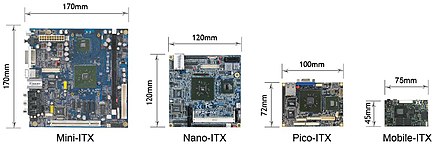
ITX motherboard form gene comparison

Comparison of the class factors for mini-ITX, mini-DTX, ATX, μATX and DTX motherboards
Mini-ITX is a 17 × 17 cm (half-dozen.7 × half dozen.vii in) motherboard form-cistron, adult by VIA Technologies in 2001.[1] They are commonly used in small-scale-configured computer systems. Originally, they were a niche product, designed for fan-less cooling with a low power consumption architecture, which made them useful for dwelling house theater PC systems, where fan noise can detract from the movie theatre feel. The four mounting holes in a Mini-ITX board line up with four of the holes in ATX-specification motherboards, and the locations of the backplate and expansion slot are the same[two] (though one of the holes used was optional in earlier versions of the ATX spec). Mini-ITX boards can therefore ofttimes be used in cases designed for ATX, micro-ATX and other ATX variants if desired.
The pattern provides one expansion slot. Before motherboards conventionally have a standard 33 MHz 5V 32-bit PCI slot. Many older instance designs apply riser cards and some even have 2-slot riser cards, although the two-slot riser cards are non compatible with all boards. Some boards based around non-x86 processors have a 3.3V PCI slot, and the Mini-ITX 2.0[3] (2008) boards have a PCI-Express ×sixteen slot; these boards are not uniform with the standard PCI riser cards supplied with older ITX (Information Technology eXtended) cases.
History [edit]

A VIA EPIA-M910 mini-ITX motherboard
In March 2001, the chipset manufacturer VIA Technologies released a reference design for an ITX motherboard, to promote the low ability C3 processor they had bought from Centaur Technology, in combination with their chipsets. Designed past Robert Kuo, VIA's primary R&D expert, the 215×191 mm VT6009 ITX Reference Lath was demonstrated in "Information PC" and ready-summit box configurations. He later designed the Mini-ITX specification. At that point, few manufacturers took upwards the ITX design, but Shuttle, Jetway, etc. produced many ITX based cube computers. Other manufactures instead produced smaller boards based on the very similar 229×191 mm FlexATX configuration.
In Oct 2001, VIA announced their decision to create a new motherboard segmentation, to provide standardized infrastructure for lower-cost PC iterations, and focus on embedded devices. The result was the November 2001 release of the VT6010 Mini-ITX reference design, in one case again touted as an "Information PC", or depression cost entry level x86 computing platform. Manufacturers were even so reluctant, but customer response was much more receptive, and so VIA decided to manufacture and sell the boards themselves. In Apr 2002 the showtime Mini-ITX motherboards—VIA's EPIA 5000 (fanless 533 MHz Eden processor) and EPIA 800 (800 MHz C3)—were sold to industrial customers.
Enthusiasts soon noticed the advantages of small size, depression noise and ability consumption, and started to push button the boundaries of case modding into something else—building computers into near every object imaginable, and sometimes even creating new cases altogether. Hollowed out vintage computers, humidors, toys, electronics, musical instruments, and fifty-fifty a 1960s-era toaster take become homes to relatively tranquility, or even silent Mini-ITX systems[ citation needed ], capable of many of the tasks of a modern desktop PC.
Mini-ITX boards primarily entreatment to the industrial and embedded PC markets, with the majority sold as majority components or integrated into a finished system for single-purpose computing applications. They are produced with a much longer sales life-bicycle than consumer boards (some of the original EPIAs are withal bachelor), a quality that industrial users typically require. Manufacturers can paradigm using standard cases and power supplies, so build their own enclosures if volumes get loftier enough. Typical applications include playing music in supermarkets, powering self-service kiosks, and driving content on digital displays.
VIA continues[ when? ] to aggrandize its Mini-ITX motherboard line. Some earlier generations included the original PL133 chipset boards (dubbed the "Classic" boards), CLE266 chipset boards (adding MPEG-2 acceleration), and CN400 boards (which added MPEG-4 acceleration). Second generation boards featured the EPIA M, MII, CL, PD, TC and MS — all tailored to slightly unlike markets. Legacy VIA boards use their x86-compatible CPUs — the C3, C7 or low-ability Eden variants, with newer boards featuring the VIA Nano CPU, launched in May 2008.[iv] Other manufacturers have likewise produced boards designed around the same layout, using VIA, but also Intel, AMD, Transmeta and PowerPC applied science.
Intel introduced a line of Mini-ITX boards for the Atom CPU, which demonstrates a meaning increase in processing performance (simply without added power consumption) over older VIA C3 and C7 offerings and helps make the design viable for personal computers. Other manufacturers saw the potential of the design, and followed adapt, some fifty-fifty non limiting themselves to the Atom, as evidenced by Zotac GeForce 9300-ITX board[5] that supports Core 2 Duo CPUs with FSB frequencies up to 1333 MHz, two separate-channeled 800 MHz memory slots and fully functional PCI Express 2.0 x16 slot that could connect through SLI to the onboard video.[half-dozen] This new wave of offerings made Mini-ITX much more popular among home users, hobbyists, and even overclockers.
Intel is currently[ when? ] one of few Mini-ITX mainboard manufacturers that listing mechanical dimensions in their manuals.[7]
Intel-based products [edit]
Onboard CPU [edit]

Intel D945GCLF2D Atom 330 Mini-ITX motherboard
A number of manufacturers take released Mini-ITX motherboards that characteristic embedded CPUs, often mobile or depression-TDP versions. These processors are designed to draw minimal power resulting in lower TDP ideal for fanless (passively cooled) configurations and embedded applications.[8] [9] [10]
Socketed CPU [edit]

Starting from LGA 775, socketed Intel Mini-ITX motherboards have been released past Intel[eleven] and Zotac.[12] [13] [fourteen] This was followed by LGA 1156 motherboards[xv] [16] [17] Starting from LGA 1155, Mini-ITX motherboards have started to become mainstream, with many dissimilar manufacturers releasing products. This is partly because almost all Sandy Bridge and Ivy Bridge Intel Celeron, Pentium and Core series CPUs have integrated processor graphics, eliminating the demand for motherboard graphics or discrete graphics cards.[18] [19] [20] [21] This trend continues with LGA 1150, LGA 1151, and LGA 1200 CPUs.[22] [23] [24] [25]
Due to the limitations of the Mini-ITX design, and the physical size of the LGA 2011 socket, Mini-ITX motherboards with the socket only support a unmarried PCI Limited expansion slot, and they require using the narrow-ILM version of the LGA 2011 socket. Despite this, manufacturers have released LGA 2011 based Mini-ITX motherboards.[26]
As well, Mini-ITX motherboards with the LGA 2066 socket accept been released, with four SODIMM slots.[27]
AMD-based products [edit]
A number of manufacturers accept released several socketed AMD Mini-ITX motherboards, supporting Socket AM2,[28] Socket AM2+,[29] Socket AM3,[30] Socket FM1,[31] [32] Socket FM2,[33] [34] [35] [36] Socket FM2+,[37] [38] [39] Socket AM1[40] [41] [42] [43] and Socket AM4 CPUs.[44] Socket AM2+ and AM3 ITX motherboards have integrated motherboard graphics, while discrete graphics or processor integrated graphics are required for other platforms.
Mini-ITX motherboards with integrated AMD CPUs are besides released.[45] [46] [47] [48] [49] [l] [51] [52] These motherboards frequently use mobile CPUs and passive cooling, and feature more powerful integrated graphics compared to their Intel counterparts, which makes them suitable for HTPC.
Transmeta-based products [edit]
IBASE made the beginning Transmeta-based Mini-ITX motherboard, the MB860. The lath uses Transmeta Efficeon processors that run at upward to 1.2 GHz. It supports SODIMM DDR modules with capacities up to 1 GB. An onboard 16 MB ATI M7 graphics controller supports 3D games and graphical intensive programs. It provides 4 USB ii.0 ports, a Realtek 8100C ten/100Mbit/due south BaseT Ethernet and an optional 8110S Gigabit Ethernet controller.
PowerPC-based products [edit]
The beginning PowerPC motherboards were produced by Eyetech[53] in 2005[54] but they stopped any activity in 2005.[55] In 2007 ACube Systems produced a new board, the Sam440ep,[56] primarily for the AmigaOS market.
ARM-based products [edit]
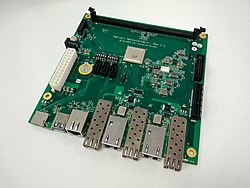
MACCHIATObin ARM-based Mini-ITX network evolution board past Marvell and SolidRun[57]
Cadia Networks developed a Mini ITX ARM board, which comes with an ARM Cortex-A8 Freescale i.MX53 serial CPU. According to the official website, the board "offers an ultra-low power SoC with a variety of I/O and OS support for Android / Linux2.6 / Windows Embedded Compact 7".
Kontron also developed a mini ITX ARM lath. According to the website, it features an "ARM Cortex-A9 Quad Cadre 900MHz Processor with NEON Engineering science", an Nvidia graphics processor, ii GB of RAM, and a targeted power consumption of < 7W for the entire board.
AppliedMicro offers the Xc-i Server Evolution Platform motherboard, which uses the X-Gene ARMv8 system on a chip with 8 2.4 GHz CPU cores, supports 128 GB DDR3 DRAM using 16 GB DIMMs, and has a baseboard management controller.
Power [edit]

Mini-ITX 2.0 SoC mainboard with ATX12V connector installed in a Micro-ATX estimator case.
The Mini-ITX standard does not define a standard for the computer power supply, though information technology suggests possible options. Conventionally Mini-ITX boards apply a xx- or 24-pin "original ATX" power connector. This is usually connected to a DC-DC converter board, which connects to an external power adapter. Generally, vendors provide both power adapter and DC-DC board with the case.
Some boards have built in DC-DC converters and converters have also been fabricated to plug directly into the ATX connector (due east.yard. the PicoPSU), either of these options avoids the demand to mountain a split up DC-DC converter into the example, saving space and design effort. Boards using full-power Intel or AMD CPUs typically apply ATX12V 2.x connections and require a case with appropriate ability supply and cooling for these more than power-hungry fries. Defined by the ATX specification, power supplies with ATX12V connector on a divide 12 volts rail must non idle that 12 volts rail.
Run across besides [edit]
- EPIA, Mini-ITX, Nano-ITX and Pico-ITX motherboards from VIA
- Domicile Theater PC
- Mini ATX, xv × fifteen cm (five.9 × 5.9 in) form gene developed by AOpen
- Mobile-ITX
- Nano-ITX
- Pico-ITX
- Plug computer
- Single-board computer
References [edit]
- ^ Mini ITX (PDF) (whitepaper), TW: VIA, archived from the original (PDF) on 2011-06-xiii .
- ^ Mini-ITX Interface Specification, version 1.1/ane.ii (PDF), Intel, archived from the original (PDF) on 2018-02-05
- ^ "Mini-ITX ii.0 Standard" (announcement). TW: VIA. Archived from the original on 2008-06-18.
- ^ VIA Nano Processor Family launch (press release), TW: VIA, May 2008, archived from the original on 2008-05-thirty .
- ^ Stores, Tom's hardware [ permanent dead link ] .
- ^ Review, Tech Report .
- ^ D425KT (PDF) (reference manual), Intel, p. 51, archived from D425KT_TechProdSpec.pdf the original (PDF) on 2012-04-25 .
- ^ Mini-ITX, Logic Supply .
- ^ "ASRock > Motherboard Series". ASRock. Archived from the original on fifteen March 2015.
- ^ "GIGABYTE - Motherboard - CPU Onboard". Gigabyte Engineering . Retrieved 15 March 2015.
- ^ "ARK: Intel Desktop Lath DG45FC". Intel ARK . Retrieved xv March 2015.
- ^ "ZOTAC nForce 630i: ZOTAC - It's time to play!". Zotac . Retrieved 15 March 2015.
- ^ "ZOTAC GeForce 9300: ZOTAC - It'south time to play!". Zotac . Retrieved 15 March 2015.
- ^ "Intel CPU: ZOTAC - It's fourth dimension to play!". Zotac . Retrieved 15 March 2015.
- ^ "GIGABYTE - Motherboard - Socket 1156 - GA-H55N-USB3 (rev. 1.0)". Gigabyte Engineering . Retrieved 15 March 2015.
- ^ Lee, Lawrence (fifteen August 2010). "Zotac H55-ITX-C-E: Stacked LGA1156 Mini-ITX Motherboard". Silent PC Review . Retrieved 15 March 2015.
- ^ "ARK: Intel Desktop Board DH57JG". Intel ARK . Retrieved 15 March 2015.
- ^ 8 Mini-ITX Mainboards for LGA1155 Processors (roundup), xBit labs, archived from the original on 29 November 2014, retrieved 15 March 2015 .
- ^ Cutress, Ian. "Z77 mITX Round-Upwardly: Five of the Best – MSI, Zotac, ASRock, EVGA and ASUS". AnandTech . Retrieved fifteen March 2015.
- ^ Soderstrom, Thomas (nine Jan 2013). "Four Z77-Based Mini-ITX Motherboards, Reviewed". Tom'due south Hardware . Retrieved 15 March 2015.
- ^ Lee, Lawrence (18 July 2013). "Gigabyte GA-H77N-WIFI Mini-ITX Motherboard". Silent PC Review . Retrieved 15 March 2015.
- ^ "ASRock > Motherboard Serial". ASRock . Retrieved 15 March 2015.
- ^ Cutress, Ian (23 July 2014). "Domicile>Motherboards Z97 Mini-ITX Review at $140: ASRock, MSI and GIGABYTE". AnandTech . Retrieved fifteen March 2015.
- ^ Soderstrom, Thomas (24 November 2013). "Five Z87 Motherboards For Your Mini-ITX Build, Reviewed". Tom'southward Hardware . Retrieved 15 March 2015.
- ^ Cutress, Ian (23 Nov 2013). "Best Mini-ITX Motherboards: Holiday 2013". AnandTech . Retrieved 15 March 2015.
- ^ Cutress, Ian (xiii March 2015). "ASRock to Debut mini-ITX Haswell-E at CeBIT: X99E-ITX/ac with USB 3.1". AnandTech . Retrieved fifteen March 2015.
- ^ "Don't Miss ASRock's New X299 Motherboards, Micro-STX DeskMini and IOT Router X10 at Computex 2017". ASRock. May 29, 2017.
- ^ Production (spec), AOpen .
- ^ Cameron Johnson (January 25, 2009). ZOTAC GeForce 8200-ITX WiFi AM2+ Motherboard (Report). TweakTown. Retrieved 15 March 2015.
- ^ "Motherboards - M4A88T-I Deluxe - ASUS". Asus . Retrieved 15 March 2015.
- ^ "ASRock > A75M-ITX". ASRock . Retrieved fifteen March 2015.
- ^ "ZOTAC A75-ITX WiFi B Series : ZOTAC - It's time to play!". Zotac . Retrieved 15 March 2015.
- ^ "ASRock > FM2A75M-ITX". ASRock . Retrieved 15 March 2015.
- ^ "ASRock > FM2A85X-ITX". ASRock . Retrieved xv March 2015.
- ^ Cutress, Ian (Baronial 21, 2013). "GIGABYTE F2A85XN-WiFi Review: FM2 and Richland in mini-ITX". AnandTech . Retrieved 15 March 2015.
- ^ "MSI Global FM2-A75IA-E53". Micro-Star International . Retrieved xv March 2015.
- ^ "ASRock > FM2A88X-ITX+". ASRock . Retrieved 15 March 2015.
- ^ "GIGABYTE - Motherboard - Socket FM2+ - GA-F2A88XN-WIFI (rev. 3.0)". Gigabyte Engineering . Retrieved 15 March 2015.
- ^ Cutress, Ian (February 23, 2014). "MSI Launches the A88XI AC, a mini-ITX FM2+ 802.11ac Motherboard". AnandTech . Retrieved fifteen March 2015.
- ^ "ASRock > AM1B-ITX". ASRock . Retrieved xv March 2015.
- ^ "ASRock > AM1H-ITX". ASRock . Retrieved 15 March 2015.
- ^ "Motherboards - AM1I-A - ASUS". Asus . Retrieved 15 March 2015.
- ^ "MSI Global AM1I". Micro-Star International . Retrieved fifteen March 2015.
- ^ Kilian, Zak (27 March 2017). "Biostar X370GTN is the first Ryzen Mini-ITX motherboard". Tech Report. Retrieved 4 May 2017.
- ^ "A68I-E350 DELUXE :: Motherboard :: BIOSTAR". Biostar . Retrieved fifteen March 2015.
- ^ "A68N-5000 :: Motherboard :: BIOSTAR". Biostar . Retrieved 15 March 2015.
- ^ "ASRock > E350M1". ASRock . Retrieved 15 March 2015.
- ^ "ASRock > C70M1 R2.0". ASRock . Retrieved 15 March 2015.
- ^ "ASRock > QC5000-ITX". ASRock . Retrieved 15 March 2015.
- ^ "Motherboards - C60M1-I - ASUS". Asus . Retrieved xv March 2015.
- ^ "Motherboards - E45M1-I DELUXE - ASUS". Asus . Retrieved xv March 2015.
- ^ "GIGABYTE - Motherboard - APU Onboard - GA-E350N (rev. 1.0)". Gigabyte Technology . Retrieved fifteen March 2015.
- ^ Product, Eyetech .
- ^ Product, Eyetech, archived from the original on March 7, 2005
{{citation}}: CS1 maint: unfit URL (link). - ^ Eyetech
- ^ Review, Acube Systems
- ^ MACCHIATObin product page, SolidRun.
External links [edit]
 | Wikimedia Commons has media related to Mini-ITX. |
- VIA Website - VIA Spearhead Initiative - Mini-ITX Mainboard Design
- Logic Supply - What is Mini-ITX?
- Micro ATX Vs Mini ITX Which Is The Right Course Factor?

What Is The Size Of The Nano-itx Form Factor?,
Source: https://en.wikipedia.org/wiki/Mini-ITX
Posted by: martinbeemeart44.blogspot.com
0 Response to "What Is The Size Of The Nano-itx Form Factor?"
Post a Comment